
Recommended products
Lieferzeit
2-3 Tage
Rhapsodie
für Posaune und Klavier
trombone and piano
Product Details
Description
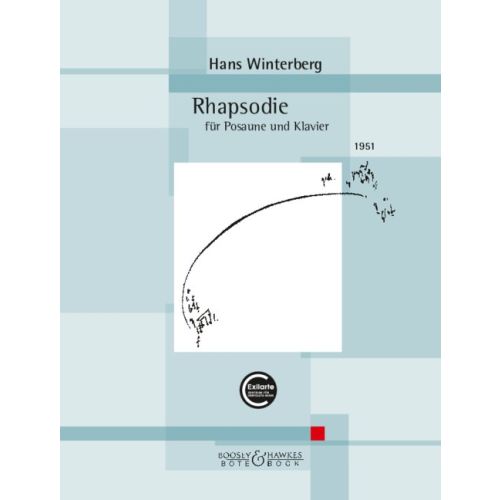
Hans Winterberg, born in Prague in 1901, belonged to the group of young Czech composers following in the footsteps of Leoš Janáček, (who died in 1928), who had received their cultural formative years in the final years of the Danube Monarchy. On the one hand, they took part in a process of national self-discovery, which was politically sealed with the attainment of state sovereignty by Czechoslovakia at the end of the First World War in 1918, but on the other hand they moved intellectually in a melting pot of influences ranging from Mahler and the Second Viennese School, which was strongly influential in Prague, to French Impressionism and Neoclassicism and German New Objectivity. Hans Winterberg, who had studied with Alexander Zemlinsky and Alois Hába, was one of the few composers of Jewish descent of this generation who survived the Holocaust and was able to further develop this specific Czech modernism in the post-war period. Shortly before the Communists seized power in 1948, he emigrated to Munich, where he enjoyed an impressive career in the years after 1950, with performances by the Munich Philharmonic Orchestra, renowned ensembles and soloists, for which he composed an impressive series of chamber music works. A treasure that is now being published for the first time in a cooperation between the Exilarte Center of the University of Music and Performing Arts Vienna and Boosey & Hawkes. The Rhapsody was composed in 1951 at the height of Winterberg's new start in Munich. In terms of form and substance, it is located between a sonatina and a sonata and has some typical Winterberg characteristics: melodies and rhythms borrowed from Czech folklore and an impulsiveness and exploration not unlike Hindemith chamber music.
More Information
Title:
Rhapsodie
für Posaune und Klavier
Level of difficulty:
virtuoso
Brand:
Bote & Bock
Year of composition:
1951
Series:
Title:
Rhapsodie
für Posaune und Klavier
Language:
German, English
Level of difficulty:
virtuoso
Brand:
Bote & Bock
Year of composition:
1951
Series:
Title:
Rhapsodie
für Posaune und Klavier
Language:
German, English
Level of difficulty:
virtuoso
Brand:
Bote & Bock
Year of composition:
1951
Series:
Technical Details
Product number:
BB 3915
ISMN13:
979-0-2025-3915-6
ISBN13:
978-3-7931-4596-7
Product number:
BB 3915
ISMN13:
979-0-2025-3915-6
ISBN13:
978-3-7931-4596-7
UPC:
196288345992
Weight:
0,15 kg
Pages:
32
Format:
23.1cm x 30.3cm
Binding:
Saddle-wire stitching
Product number:
BB 3916 Q781651
ISMN13:
979-0-2025-3916-3
ISBN13:
978-3-7931-4596-7
Pages:
26
Format:
23.1cm x 30.3cm
File format:
(PDF / 649.97 KB)
Preview/Media Contents
Video:
Turning Points - Episode 2: Hans Winterberg
Video:
Turning Points - Episode 2: Hans Winterberg
Video:
Turning Points - Episode 2: Hans Winterberg
More from this series
Chamber Music Hans Winterberg
Hans Winterberg, born in 1901 into a Jewish family that had lived in Prague for centuries, studied with Alexander von Zemlinsky and Alois Hába. Until the annexation of Czechoslovakia by Nazi Germany in 1939, he worked as a conductor, pianist, and composer. Unlike his friends and colleagues Viktor Ullmann, Hans Krása, and Gideon Klein, he survived the Shoah through a series of miracles. In 1945, he moved to Munich, where he began a promising second career. As a representative of a moderate avant-garde, he found himself increasingly marginalized from the late 1960s onwards. After his death in 1991, his artistic estate was locked away in a German music archive and, since none of his works had been published during his lifetime, he was forgotten. Since 2023, Boosey & Hawkes has been publishing Winterberg's chamber music in an extraordinary edition project as first editions in cooperation with the Exilarte Research Center at the University of Music and Performing Arts Vienna. They reveal music of unique charm, in which influences from Janáček, the Second Viennese School, and French Impressionism are amalgamated into an original and exciting personal style.
Following the chamber music, the edition project will focus on the first editions of Winterberg's piano works and songs.


Reviews
Only registered users can write reviews. Please Sign in or create an account


