
Recommended products
Lieferzeit
2-3 Tage
As low as
£43.49
Regular Price
£57.99
Incl. VAT
Product Details
Description
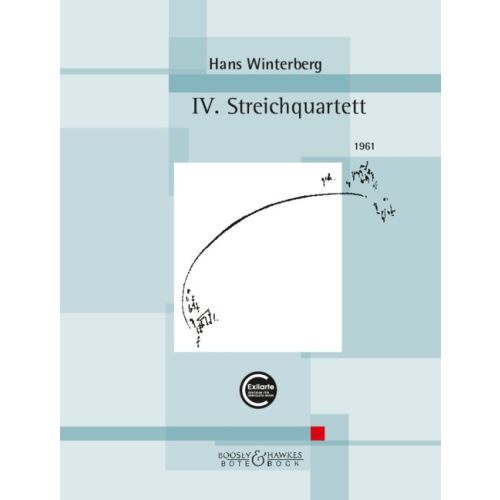
Hans Winterberg's four string quartets were composed over a period of four decades between 1936 and 1961 and reflect the four stages of his eventful biography. He composed the first in what were probably the happiest moments of his life in his native city of Prague, the second under great hardship in the terrible war year of 1942, the third in 1957 during a phase of great compositional success in his adopted home of Munich, and the fourth in another dramatic phase of his life. It came at a moment of renewed doubt and uncertainty, when a young generation of composers in Europe was vehemently asserting itself, breaking with all traditions because it considered them obsolete and corrupted by fascism. Winterberg, a survivor of the Shoah, did not break with the past, but rather tried to continue the Czech-German-Jewish cultural symbiosis in his compositions after the war. The fourth quartet marks the beginning of a new creative phase in which he succeeded in combining the very different influences that shaped him - the Bohemian-Moravian, folk-inspired tradition as a successor of Janáček and the achievements of the Second Viennese School, imparted by his teacher Alexander Zemlinsky - into a homogeneous, rhythmically pointed and expressive style.
More Information
Title:
IV. Streichquartett
Edition:
Score and parts
Level of difficulty:
virtuoso
Brand:
Bote & Bock
Year of composition:
1961
Series:
Title:
IV. Streichquartett
Language:
German, English
Edition:
Score and parts
Level of difficulty:
virtuoso
Brand:
Bote & Bock
Year of composition:
1961
Series:
Title:
IV. Streichquartett
Language:
German, English
Edition:
Score and parts
Level of difficulty:
virtuoso
Brand:
Bote & Bock
Year of composition:
1961
Series:
Technical Details
Product number:
BB 3913
ISMN13:
979-0-2025-3913-2
ISBN13:
978-3-7931-4595-0
Product number:
BB 3913
ISMN13:
979-0-2025-3913-2
ISBN13:
978-3-7931-4595-0
UPC:
196288325291
Weight:
0,51 kg
Pages:
140
Format:
23.1cm x 30.3cm
Binding:
Saddle-wire stitching
Product number:
BB 3914 Q781650
ISMN13:
979-0-2025-3914-9
ISBN13:
978-3-7931-4595-0
Pages:
129
Format:
23.1cm x 30.3cm
File format:
(PDF / 3.68 MB)
Preview/Media Contents
Video:
Turning Points - Episode 2: Hans Winterberg
Video:
Turning Points - Episode 2: Hans Winterberg
Video:
Turning Points - Episode 2: Hans Winterberg
More from this series
Chamber Music Hans Winterberg
Hans Winterberg, born in 1901 into a Jewish family that had lived in Prague for centuries, studied with Alexander von Zemlinsky and Alois Hába. Until the annexation of Czechoslovakia by Nazi Germany in 1939, he worked as a conductor, pianist, and composer. Unlike his friends and colleagues Viktor Ullmann, Hans Krása, and Gideon Klein, he survived the Shoah through a series of miracles. In 1945, he moved to Munich, where he began a promising second career. As a representative of a moderate avant-garde, he found himself increasingly marginalized from the late 1960s onwards. After his death in 1991, his artistic estate was locked away in a German music archive and, since none of his works had been published during his lifetime, he was forgotten. Since 2023, Boosey & Hawkes has been publishing Winterberg's chamber music in an extraordinary edition project as first editions in cooperation with the Exilarte Research Center at the University of Music and Performing Arts Vienna. They reveal music of unique charm, in which influences from Janáček, the Second Viennese School, and French Impressionism are amalgamated into an original and exciting personal style.
Following the chamber music, the edition project will focus on the first editions of Winterberg's piano works and songs.


Reviews
Only registered users can write reviews. Please Sign in or create an account


